Riskomat Platform
Riskomat is our prototype-based Decision Intelligence for Critical Operations, implementing the Hagenberg Risk Management Process, which we continuously research and publish on. This platform stands at the center of case studies and extensions that automate incoming events and outgoing decisions.
- Triage of risks via multidimensional Polar Heatmaps
- Modeling of causes, barriers, and consequences
- Operationalization as a real-time monitoring model
- Real-time monitoring and automated decision-making
The entire workflow is designed around regulatory requirements and optimized for quick iterations.
Risk Triage with Polar Heatmaps
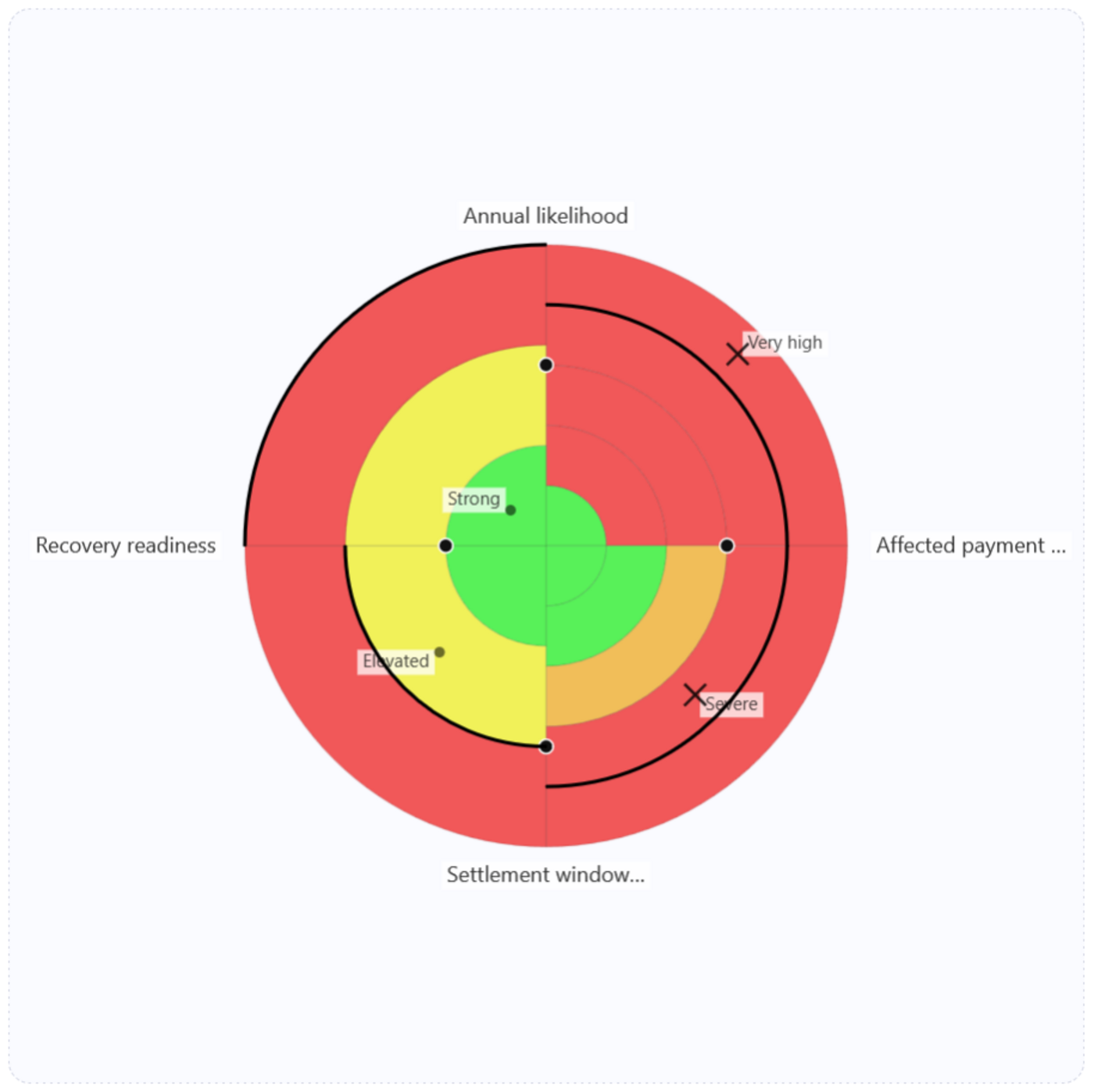
Risks are managed and visualized based on likelihood, impact, and additional context dimensions (e.g., redundancy, operating mode, environmental conditions). The Polar Heatmap maps each context combination to its own risk class, avoiding classic ranking errors from 2D matrices.
The Heatmap is designed to enable immediate, traceable prioritizations and to support the documentation of thresholds required by regulations (NIS2/DORA).
Causal Risk Modeling
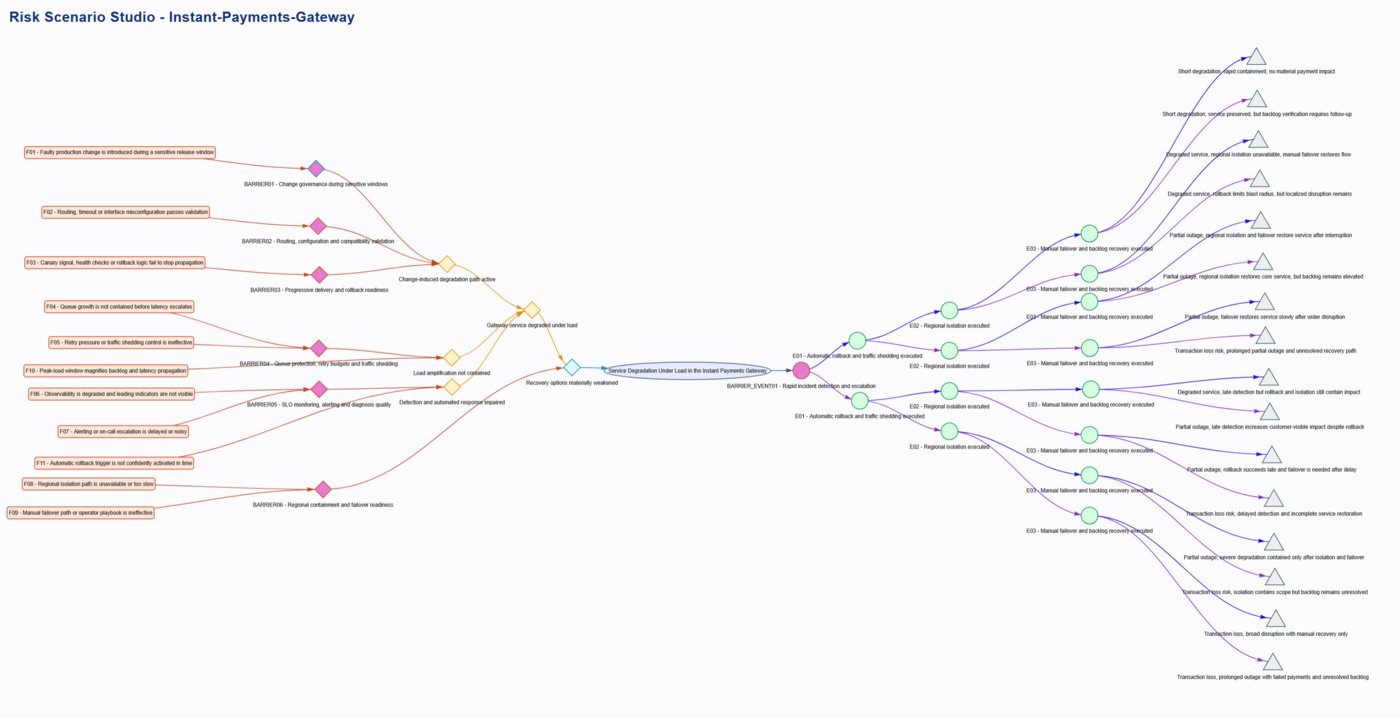
Risks identified as critical after triage must be further modeled. In Riskomat's Risk Scenario Studio, the causes leading to the risk's occurrence as well as the consequences upon occurrence of the critical event can be further modeled under additional influence of context factors. Only then can causes, consequences, and consequence paths be clearly identified, suitable intervention points (preventive, detective, mitigative, corrective) be defined, and explicitly represented in the model. If it turns out that an intervention is not or only partially possible, risks may need to be monitored in real time to enable a timely response.
Transformation to Real-Time Monitoring
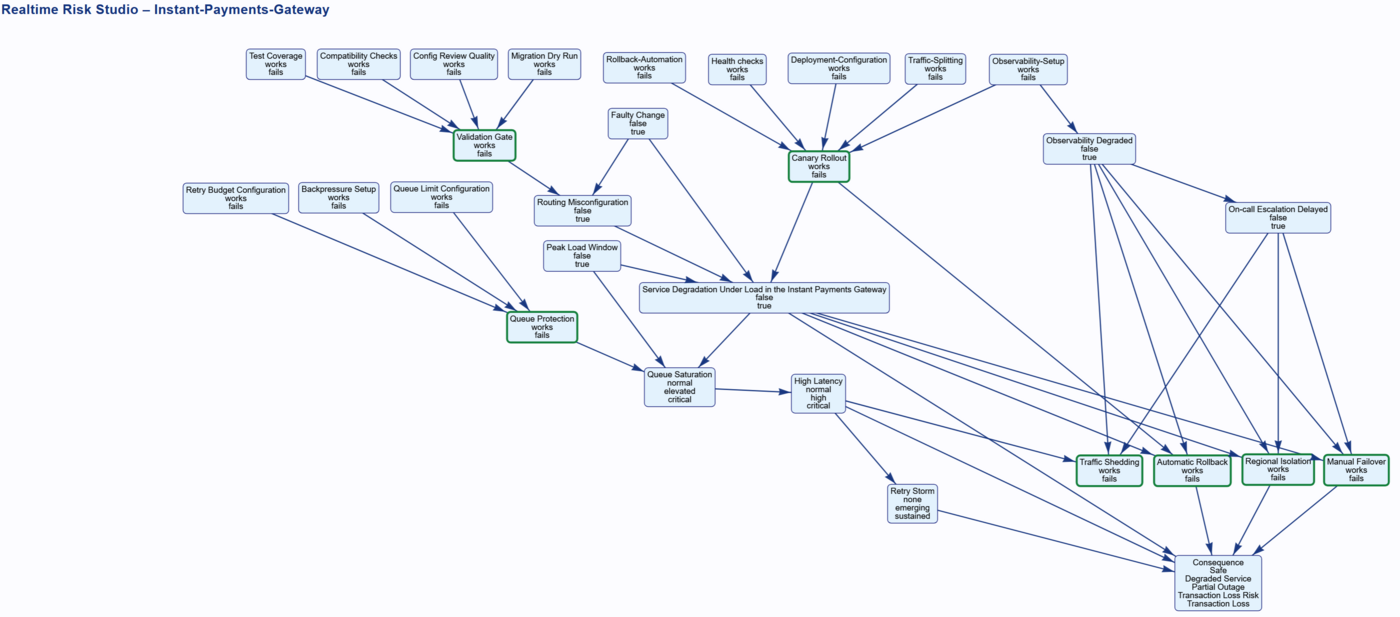
Using the Realtime Risk Studio in the Riskomat prototype, a model for real-time risk monitoring can be generated from the previously conducted causal risk analysis and then further modeled. Here, the previously defined intervention points become nodes at which countermeasures can be activated during monitoring. In addition to the possibility of extending the model by integrating additional necessary events, conditional occurrence probabilities are now also added to the nodes of the model. The prototype includes an integrated framework for empirical surveys and their analysis. Furthermore, an AI assistant can be included at this step as well as during the modeling itself.
Continuous Monitoring and Decision Support
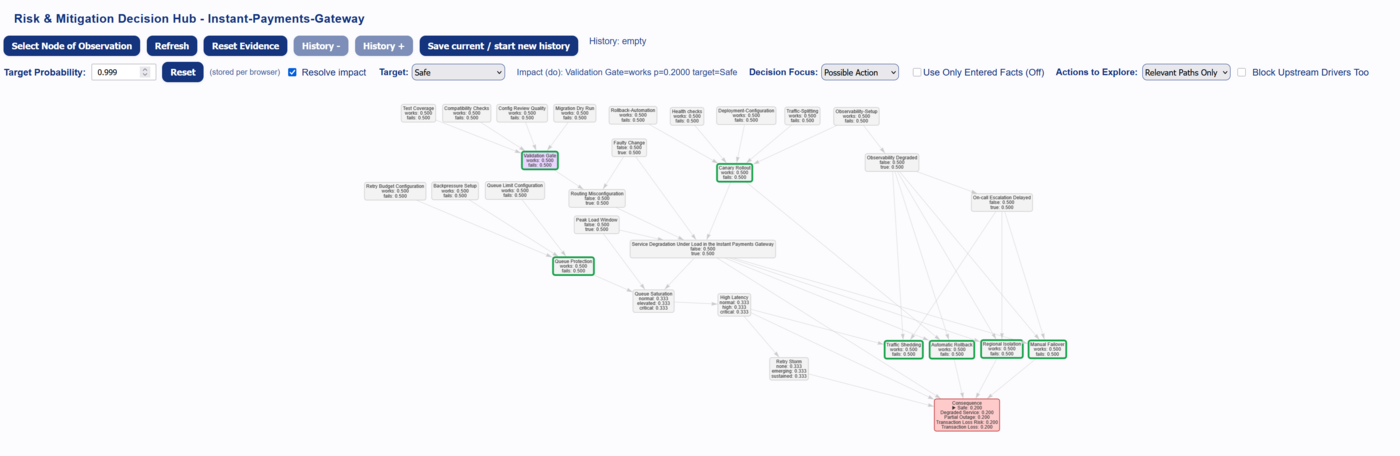
For risks and their consequences that cannot be sufficiently mitigated, all relevant event states must be monitored in real time wherever possible. Only this enables a timely response. The Risk & Mitigation Decision Hub in the Riskomat prototype enables monitoring of the current system state and triggering of actions based on escalation rules. The optimal action recommendation and its impact on the system, based on a causal do-analysis, is continuously determined and proposed from all existing options for the current system state. In addition, possible upcoming state changes of the system, based on the current real state, can be simulated and the optimal response determined hypothetically again. All steps and state changes are recorded in a history, which provides an ideal basis for later processing of escalation procedures as well as supporting audits and regulatory reports.